Is This You

If any of these sound familiar, you're in the right place.

You keep the books for a nonprofit. You know how to enter transactions, but restricted funds, grants, and fund accounting still feel like a foreign language.

You serve on a nonprofit board. You're responsible for the organization's finances, and you'd like to actually understand the reports you're approving.

You work or volunteer for a nonprofit. Maybe you're the executive director, the program manager, or the person who just got handed the finances. Either way, you need to know how it all works.

You run a bookkeeping business and want nonprofit clients. Then you need to know where nonprofit accounting differs, and where it doesn't.

By the End, You'll Be Able To:

Not just what to do. Why you're doing it.

✓ Explain how nonprofits are structured and governed, and how their accounting differs from for-profit businesses.

✓ Understand tax-exempt status, IRS requirements, nonprofit tax filings, and unrelated business income tax.

✓ Recognize the internal controls that help prevent and detect fraud.

✓ Set up a segmented chart of accounts and use fund accounting with confidence.

✓ Record contributions and grants correctly, including donor restrictions and allocated funds.

✓ Prepare and read all four nonprofit financial statements, and understand what they say about the organization's health.

No memorizing. No guessing. Just clarity.

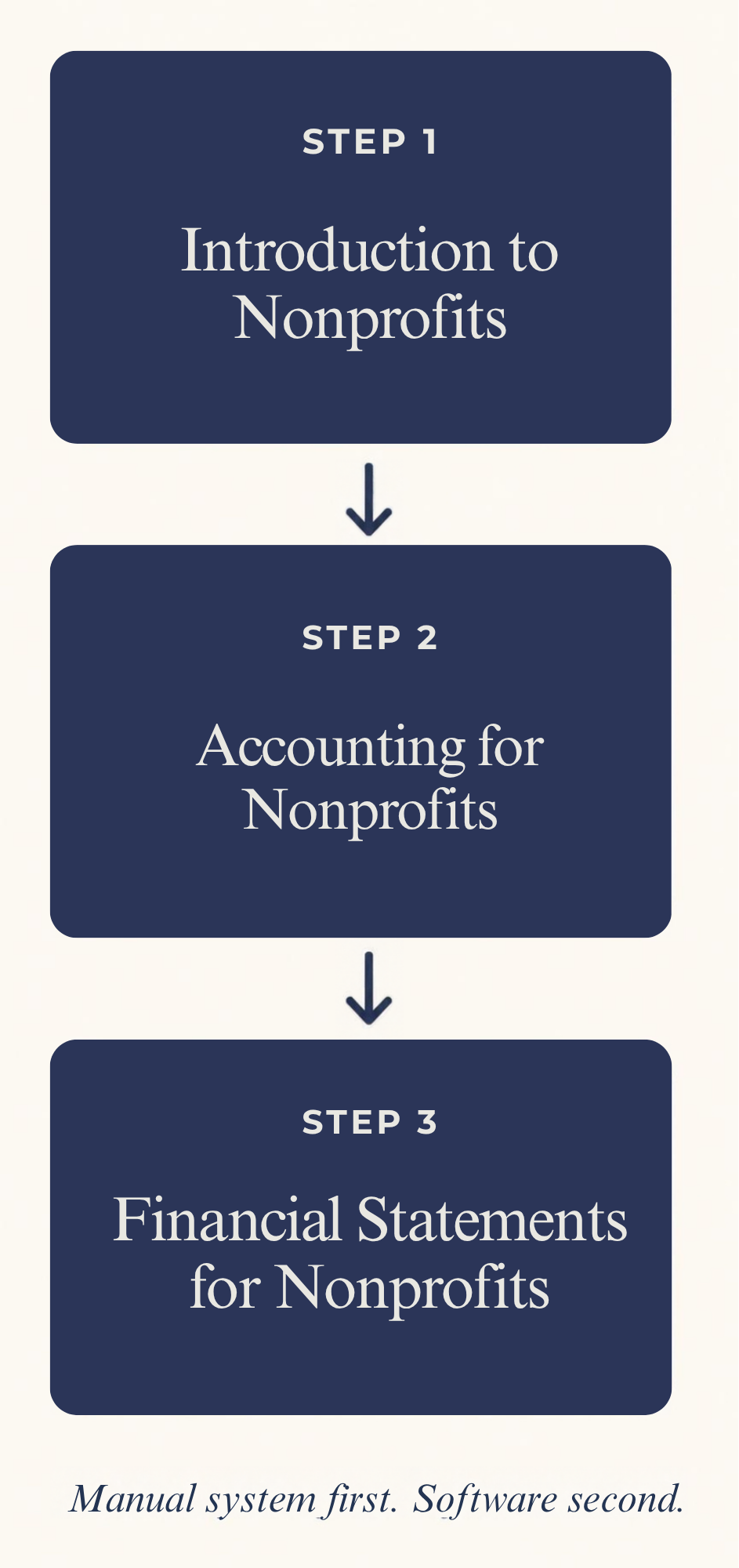
Three Courses. One Path. In This Order.

Each course builds on the one before it so the order is important!

Step 1: Introduction to Nonprofits. The foundation. How nonprofits are structured and governed, how they stay tax-exempt and compliant, and how internal controls protect them.

Step 2: Accounting for Nonprofits. The bookkeeping. Fund accounting, the segmented chart of accounts, and how to record contributions, grants, and donor restrictions.

Step 3: Financial Statements for Nonprofits. The finish line. You'll prepare and interpret all four nonprofit financial statements and see how they reveal an organization's ability to deliver on its mission.

The rules of accounting don't change for nonprofits. How you track and allocate the money does. Learn it by hand first, and you'll understand every report your software produces.

Data entry is not bookkeeping. Understanding your numbers is.

Here's Everything You Get

One price. No surprises.

All three courses in the Nonprofit Accounting Essentials Certificate Program, taken in order.

A Certificate of Completion when you finish the program.

Access to the Bookkeeping Community, so you're never learning alone.

$110 in savings compared to buying each course separately ($555 vs. $445).

A payment plan option: 2 payments of $222.50, no extra cost.

Hi. I'm Sharon.

Your Instructor, and your biggest cheerleader.

I spent 10 years in corporate accounting before I started teaching, and I've now been teaching bookkeeping and accounting for 22 years through continuing education and workforce development programs at universities and colleges.

I hold a Bachelor's degree in Business Education from Temple University, a Pennsylvania Department of Education teaching certificate in Accounting, and I'm a Certified Online Instructor.

But here's what matters most: so many of my students walk in convinced they're "not a numbers person." Most of them are wrong. They just never had it explained clearly. Bookkeeping and accounting definitely involve math, but not in the way one thinks. Bookkeeping is a filing system for numbers and every number has a place to be kept. The system of debits and credits is the filing system.

That's my job. Plain English, step by step, until it clicks.
Sharon deFonteny, Bookkeeping and Business Finance Educator

Questions? Good. Here Are the Answers.

  • I'm on a nonprofit board. Is this for me?

    Absolutely. Board members are responsible for an organization's finances, and this program helps you understand the reports you're reviewing and approving, so you can ask the right questions.

  • Do I need bookkeeping experience first?

    It definitely helps, but it isn't required. Accounting for Nonprofits covers the account categories, the accounting equation, and the rules of debits and credits before moving into nonprofit-specific topics. If you'd like a deeper foundation first, the Bookkeeping Essentials Certificate Program is a great place to start.

  • Do I need accounting software?

    No. You'll learn the manual system first, which is exactly the point. Once you understand what's happening behind the scenes, any software becomes easy.

  • Do I have to take the courses in order?

    Yes, and you'll be glad you did. Each course builds directly on the one before it.

  • Is this a professional certification?

    No. This is a Certificate Program, and you'll earn a Certificate of Completion. It's designed to give you real, practical understanding you can use right away.

  • How does the payment plan work?

    You pay $222.50 today and $222.50 next month. Same $445 total. No extra fees.

  • What is the Bookkeeping Community?

    It's a place for students across all of my courses and Certificate Programs to ask questions, share what they're working on, and connect with others learning the same material. It's included with your purchase.

  • Can I buy just one course instead?

    Yes, each course is available individually for $185. But the full program saves you $110, includes the payment plan option, and since the courses build on each other, the bundle is the way to go.